
Weekly notes
Posts
A note each week. Writing, a cover, pictures, video, and charts — whatever that week has.
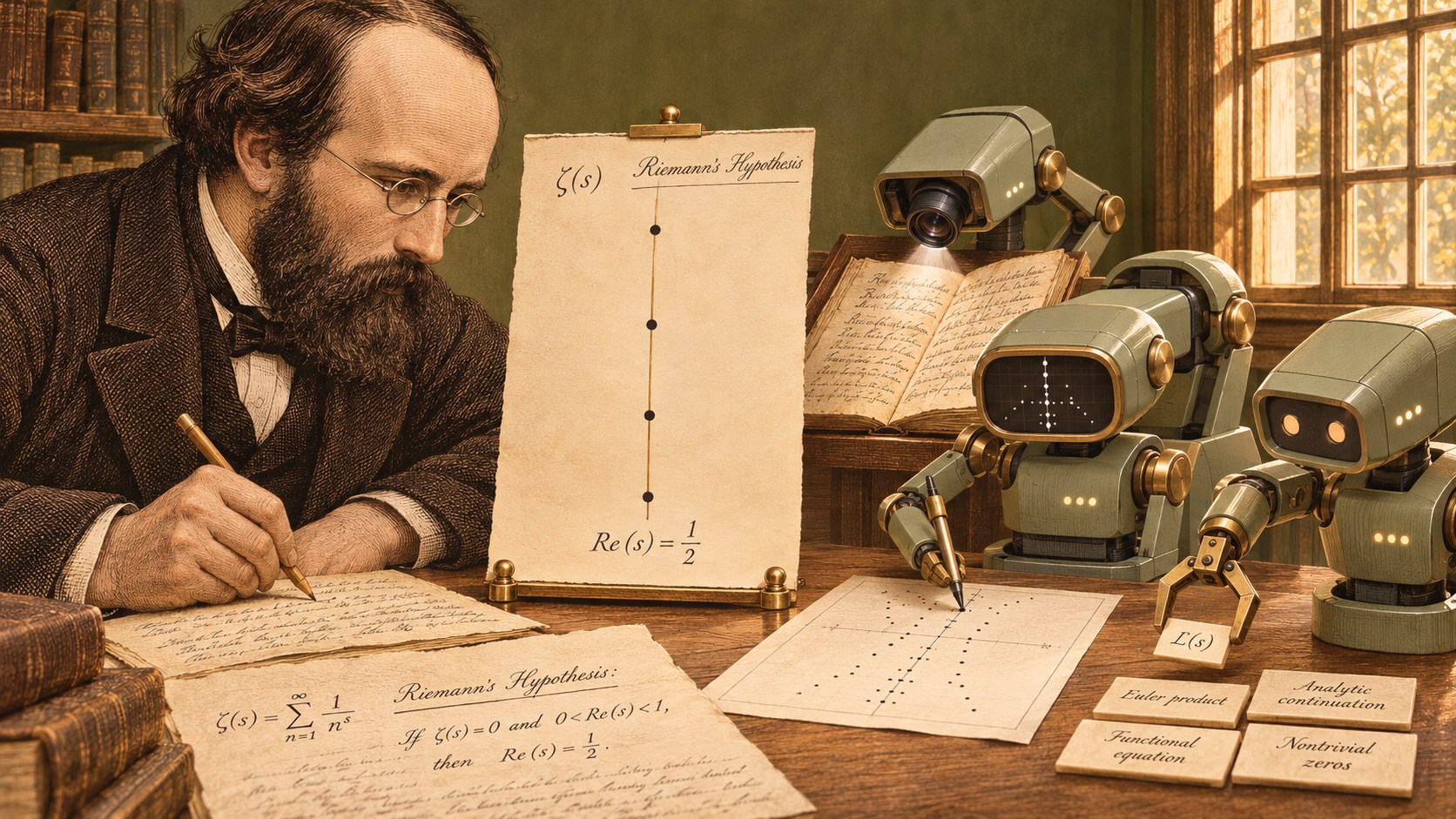
From the Riemann Hypothesis to AI-driven discovery
A Claude-assisted proof of the Riemann Hypothesis shows how far AI can push mathematical research. The next question is how to build a discovery process around evidence that other scientists can check.
Read note
The story of AgentUV.
Years of application development, three years focused on AI agents, a master's degree in water management, and startups in fintech and healthcare. This is why I started AgentUV, and why I start with small agents for environmental science.
Read note
Open models and harnesses for AI-driven science.
I think the next ten years will bring the fastest progress in science, and agents are the reason. These are the open models and research harnesses that I would start with, and the license of each one.
Read note
Small models, edited by large ones.
A frontier model fixed a known failure in Qwen3.5-0.8B by editing 0.016% of its weights, with no training. I think this can make small models improve much faster.
Read note
The new job for developers.
Writing code is becoming like writing machine code. I see two paths for developers - build intelligence, or build and sell a product alone.
Read note
The road I will not regret.
When I look back at my years of work, I regret what I did not try. Now I want to start something bold.
Read note
GRPO, GSPO, and CISPO in simple words
Three reinforcement learning algorithms for language models. They start from the same group reward, but they apply the importance ratio and clipping in different ways.
Read note
Programming has no moat.
Building a product is becoming easy for everyone. Science is the field that still has room for deep knowledge.
Read note
The harness makes the model stronger.
GPT-4 on SWE-bench Lite runs from 2.7% with retrieval to 28.3% with CodeR. GPT-4o runs from 18.3% in SWE-agent to 32% in Agentless. The weights stay put. The tools, the memory, and the check do the moving.
Read note
Six months of recursive self-improvement, and what they do to future research
From April to October 2026, the loop made coding tasks longer and returned mathematics a check can accept. Future research takes that speed where a check is strong, and slows where a person still chooses the question.
Read note
Ten open models under a billion parameters, ranked for a fine-tune
I went through the Hugging Face catalog for models under a billion parameters, wrote down the training stage, the license, the likes, and the downloads, and kept ten anyone can run or fine-tune.
Read note
Swarms of agents spent weeks on the work. Human review started to fall behind.
In June 2025, an agent improved a math result that was 56 years old. In October 2026, one model published 719 manuscripts. A machine could check the work.
Read note
I put decision models in a house with mid-level LLMs. They took the scoreboard and the clock.
I wanted a straight test of decision models: are they actually better than mid-level chat models, and are they faster? I locked both kinds in the same house, gave them one goal, and ran it five times. Jev finished first and answered in a fraction of the time.
Read note