
From the Riemann Hypothesis to AI-driven discovery
A Claude-assisted proof of the Riemann Hypothesis shows how far AI can push mathematical research. The next question is how to build a discovery process around evidence that other scientists can check.
On November 20, 2026, the number theorist Levent Alpöge released a proof of the Riemann Hypothesis developed with Claude. The proof came as a library written in Lean, a language and proof assistant that can check mathematical arguments. The next day, the Lean Focused Research Organization and the Mathlib Initiative reported that independent checkers had accepted the proof and confirmed that it established the standard statement of the hypothesis. The archive contained about 17 million lines of code. Alpöge’s announcement · Joint verification statement
What interests me most is the question that came next. Once a computer can check an argument of that size, how do researchers find the ideas inside it that are worth carrying into the next problem? And what would this way of working look like in a field where the final check has to happen in a lab?
Why the primes lead to a vertical line
Prime numbers thin out as you count higher. Around a large number x, roughly one in every log(x) integers is prime, where log is the natural logarithm. That gives us the average density. The actual count still fluctuates, and number theorists want to know how large the gap between the count and a smooth estimate can get. Clay Mathematics Institute’s overview
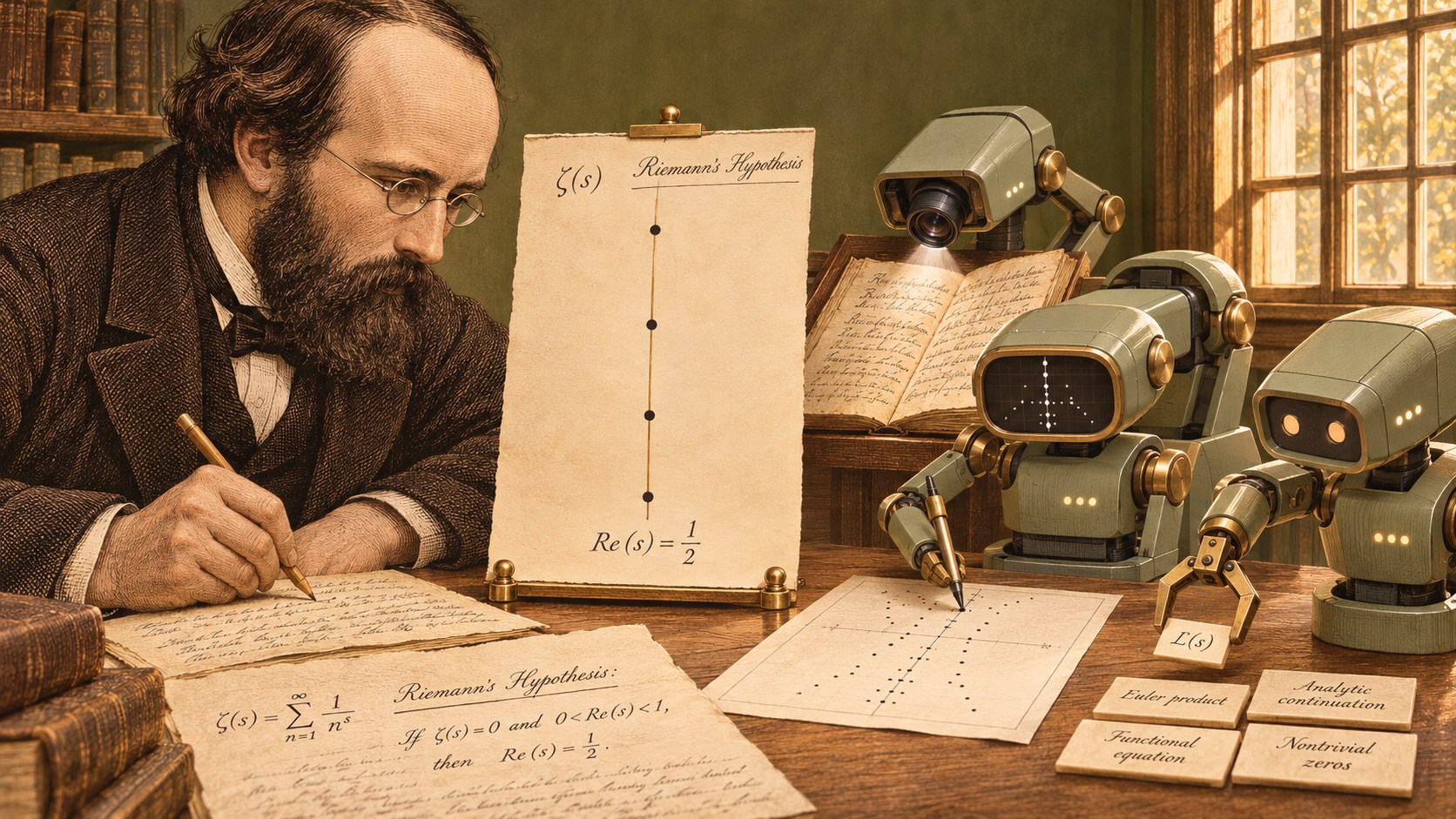
Riemann approached that question in 1859 through the zeta function, written ζ(s). In the region where its defining series converges, it can also be written as a product with one factor for each prime. This connection runs deep enough that the locations where ζ(s) equals zero tell us about the fluctuations in the count of primes. Riemann’s hypothesis puts every nontrivial zero on the same vertical line in the complex plane, where the real part of s is ½. If even one nontrivial zero lay off that line, the statement would fail. Placing all of them on the line gives a strong bound on how far the count of primes can deviate from its smooth estimate. Enrico Bombieri’s official problem description
What Claude and Alpöge contributed
In a separate effort in August, Anthropic reported that Claude had raised a lower bound on the long-run share of nontrivial zeros on the line from 41.6% to about 67.2%. Anthropic says that around 60 subagents contributed to the search or review. Some explored possible arguments, some looked for counterexamples, and others tried to rederive the result. The improvement was substantial, and the universal claim still needed an argument that covered every zero. Anthropic’s August research report
In the November work, Alpöge describes combining two ideas in a simpler setting and guiding the search toward an analogous setup for the original problem. He credits Claude with a decisive suggestion about how to iterate a construction called a theta lift. The formal checks also covered the generalized hypothesis for Dirichlet L-functions. As of November 24, Clay still listed the Riemann Hypothesis as an active Millennium Prize Problem. Its prize process requires publication in a qualifying outlet, a wait of at least two years after publication, and general acceptance by the mathematical community. Alpöge’s account · Independent verification record · Clay’s problem page · Official prize rules
The community could verify the result before it had a short explanation that another number theorist could learn from. Alpöge says he wants to simplify and explain the argument. That work matters for discovery. A checked proof settles a statement. A clear explanation can show which step did the real work, where else it might apply, and which assumptions someone could weaken next. Alpöge’s remarks on the write-up
How I would organize a research team around agents
I would start with a question a researcher cares about and ask what evidence would change their mind. Then I would give agents different jobs, tools that return real results, and a shared record of what has already been tried.
- Explore several plausible explanations. Have agents read the literature, reproduce a known result, and follow different leads. Give each branch a specific question so that parallel work covers more ground.
- Look for the cheapest decisive check. Try a small counterexample, an independent derivation, or an experiment in which two hypotheses predict different outcomes. In math, formalize the step the argument depends on. In a lab, use the next measurement to resolve the uncertainty that matters most.
- Keep the evidence with the claim. Save the exact theorem, code, data, or lab record, along with assumptions and failed attempts. Have a separate reviewer try to reproduce the result from those materials.
- Use the result to choose the next question. A failed calculation can reveal a missing assumption. A well-designed experiment that rules out one explanation can narrow the search. Either result can justify a new branch.
I would give agents a fixed budget for exploration and keep some evidence in reserve for the final check. Agents that share a model and read the same papers can converge on the same mistake. A second derivation with different assumptions or a test on data held back from the search can reveal a problem that another round of discussion would miss.
AlphaProof and AlphaEvolve show two ways to make that feedback concrete. AlphaProof used Lean to check proof steps and solved three non-geometry problems at the 2024 International Mathematical Olympiad. AlphaEvolve used automated evaluators to guide a search over programs and found a way to multiply two 4 × 4 complex matrices using 48 scalar multiplications. A proof checker can verify a formal claim. An evaluator can measure a candidate against a defined objective. The research team still has to decide whether that claim or objective captures what it wants to learn. AlphaProof research paper · AlphaEvolve technical report
How the same approach could work in other sciences
Materials science already offers an example. The A-Lab project used computational predictions and past research to guide robotic experiments on inorganic materials. Measurements from one attempt informed the next. In a future battery study, an agent could use this approach to propose several explanations for why a material degrades, then prioritize the experiment most likely to tell those explanations apart. A promising result would still need to hold up in fresh samples and under the conditions the material is meant to face. A-Lab research paper
Google’s Co-Scientist offers a different example. Its agents generated, critiqued, and revised hypotheses in response to research goals set by scientists. In a 2026 study, the researchers reported that laboratory experiments supported some of the system’s proposals. That is a useful division of work. The agents can sift through more ideas than a team has time to try, while the researchers choose which measurements can justify a conclusion and how far that conclusion reaches. Co-Scientist research paper
I think this approach will spread wherever a field can give agents reliable feedback. In observational astronomy, that might mean checking a prediction on data from another instrument. In materials science, it might mean having another lab reproduce a measurement. I would judge these systems by how quickly a team gets to a result that an independent group can check and use. The outcome I’m most excited about is a discovery that gives the next scientist a question they would never have thought to ask.